The challenge
Manual sorting of unordered parts or materials in harsh, high-mix production settings is error-prone and limits throughput.
- Human involvement introduces risk, causes variability and rework, reducing process stability
- Conventional sorting systems cannot handle randomly positioned or irregularly shaped objects with the required precision and speed.
- Rigid automation setups lack flexibility to meet changing production demands.
The Solution
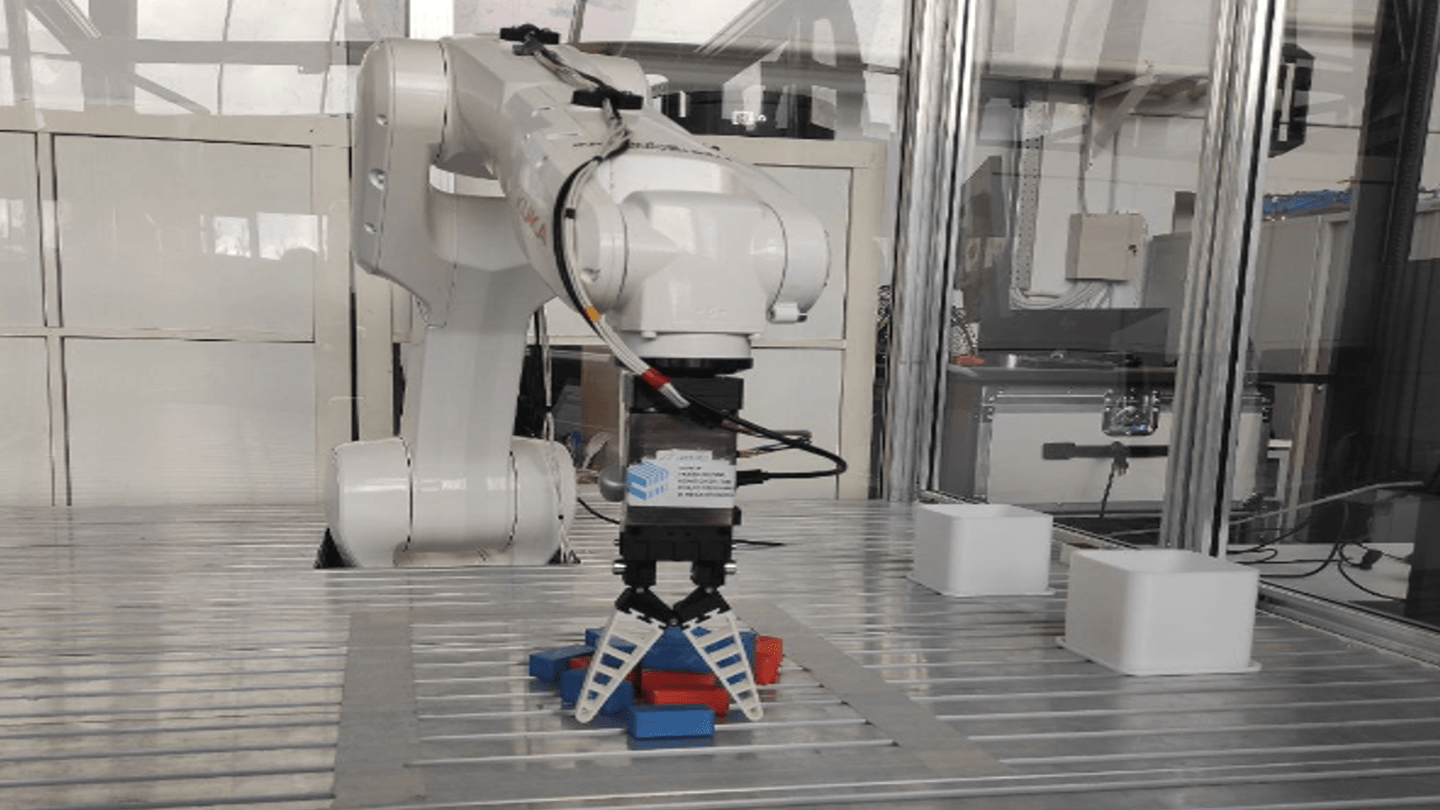
A robotic cell was developed based on an industrial robotic arm, integrated with a vision system and AI-driven software.
- Computer vision + neural network recognize objects of any shape or color after training.
- Intel RealSense camera integration enables real-time 3D data acquisition.
- Smart grasp selection algorithm chooses the optimal object to pick based on location and orientation.
- Built-in fallback logic allows repositioning when capture is initially impossible.
- Scalable architecture supports quality control modules and integration with Computer Numerical Control (CNC) machines.
Impact
- Human operators are fully removed from the process
- Process acceleration boosts throughput by 3–5× while ensuring sharply reduced error rates.
- Consistency keeps results stable across production cycles.
- Operational flexibility handles unordered and mixed objects, freeing staff for higher-value tasks.
Industrial Directions
- Industrial waste plants
- Manufacturing & precision engineering: complex object sorting, CNC machine tending
- Logistics & warehousing: sorting parcels and mixed items on conveyors
- Automotive & aerospace: preparing and verifying parts for downstream operations
- Aerospace, Automotive, Environmental & Sustainability, Industrial Automation, Logistics & Supply Chain, Manufacturing & Engineering, Materials Handling, Precision Engineering