The challenge
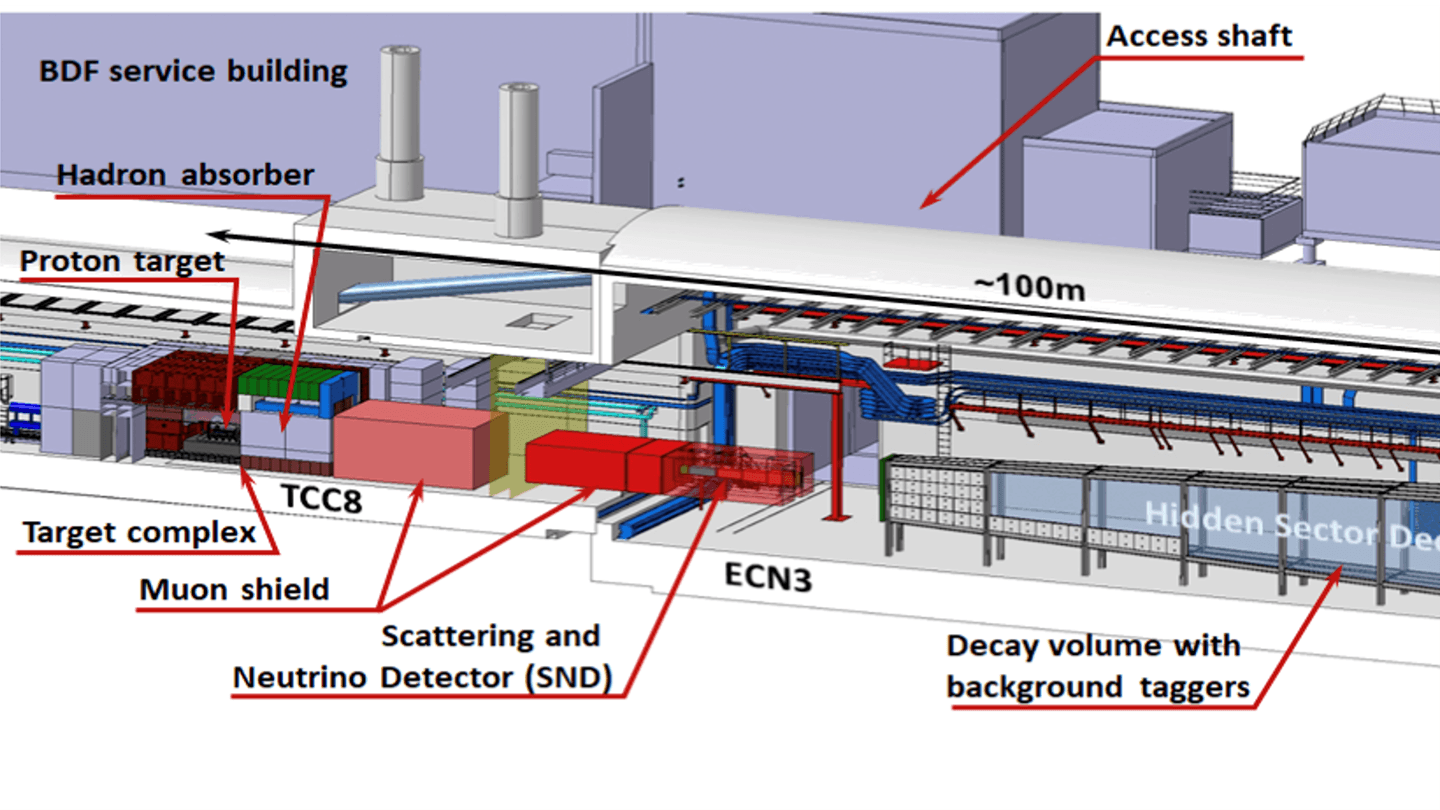
- The CERN SHiP straw spectrometer tracker has 32 tunable design variables.
- Classical reconstruction and loss are non-differentiable, forcing slow black-box optimization.
- Model-free Bayesian optimization (GP) scales poorly beyond ~10 dims, and full-simulation geometry evaluation is costly.
The Solution
- Surrogate-based detector co-design, using neural networks to make the optimization loop differentiable end-to-end.
- Joint training of a reconstruction NN + a generative model of detector response (VAE/diffusion).
- Stochastic gradient optimization over geometry parameters, validated against FairShip full simulation.
Core innovations:
- Differentiable surrogates: Reconstruction + generative NNs replace black-box simulators with gradient-aware proxies.
- Distribution-aware loss: Captures both distribution shifts and reconstruction quality in one gradient.
- 30+ dimensional scaling: Tractable co-design where classical GP/BBO fails, with multi-start for local minima.
Impact
- SHiP collaboration: Proof-of-concept shows improved tracker RMSE (Vₓ 60.6→42.7 mm) under optimized geometry.
- CKL: Reusable co-design toolkit for non-differentiable simulators — applicable beyond SHiP.
- The Field: Scalable path to detector co-design in 30+ dimensions, beyond the reach of classical Bayesian Optimization.
Industrial Directions
- High-energy physics experiments (CERN, FAIR, DESY) — detector design and co-design.
- Scientific instrumentation R&D (imaging, spectrometry, medical physics).
- Neural-surrogate-based engineering design (differentiable co-design toolchains).
- Aerospace, Artificial Intelligence, Materials Science & Engineering, Medical Physics, Nuclear Industry, Precision Physics, Quantum Computing, Research Infrastructure, Science & Research, Scientific Instrumentation