The challenge
- Discovering new stable crystalline materials is crucial for batteries, semiconductors, catalysts, and pharmaceuticals.
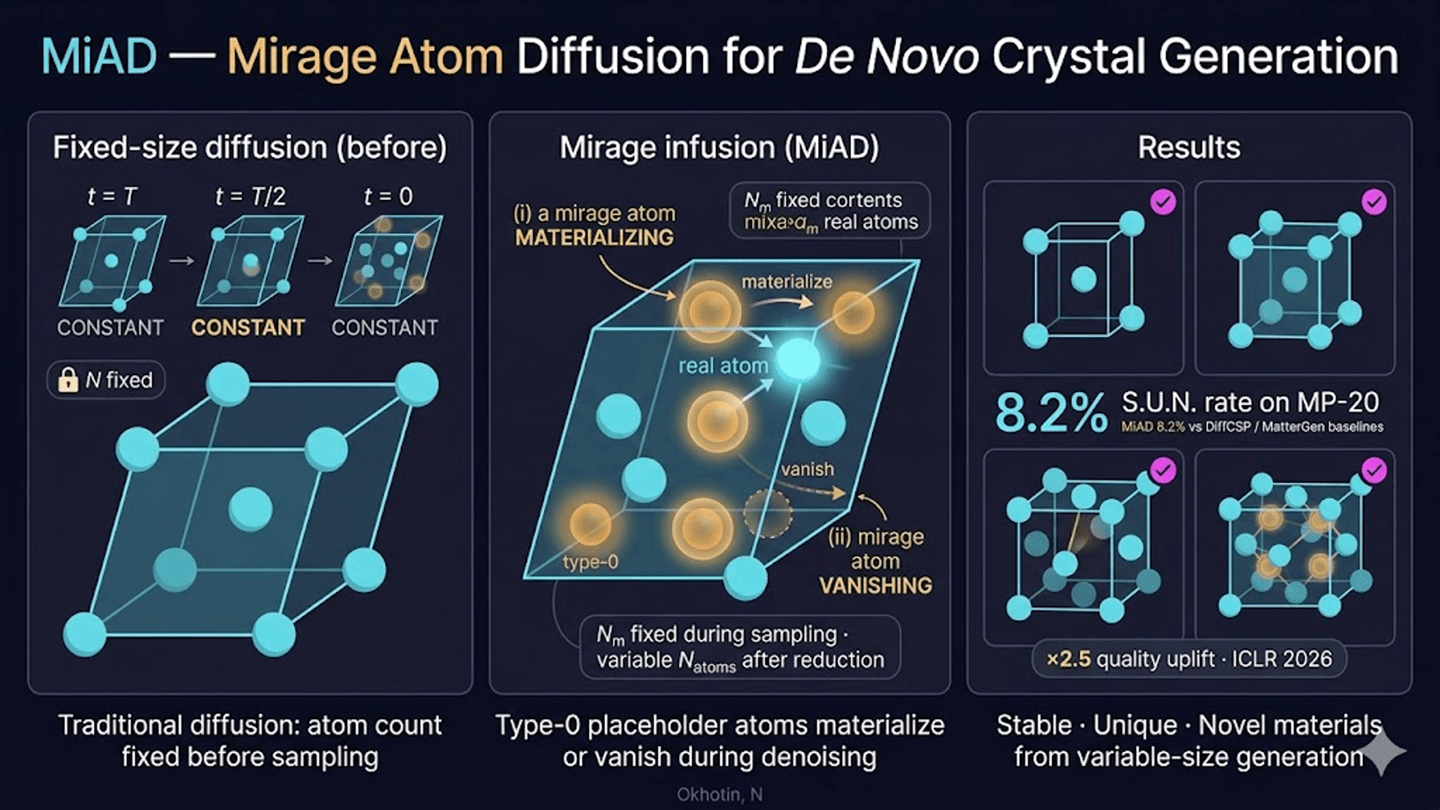
- Diffusion models (DiffCSP, MatterGen) lead the field but are restricted to a fixed number of atoms during generation.
- Fixed atom count limits trajectory flexibility and hinders exploration of plausible crystal structures.
The Solution
- MiAD: a joint diffusion model for de novo crystal generation that can change the number of atoms during generation.
- Core technique — mirage infusion: placeholder atoms (type 0) that materialize into real atoms or vanish during denoising.
- Drop-in augmentation for any joint diffusion model (DiffCSP-style); preserves crystal symmetries and equivariance.
Core innovations:
- Mirage atom type: New discrete type “0” lets the model freely materialize or annihilate atoms during generation.
- Infusion + masked loss: Real crystals augmented with extra mirage atoms; coordinate loss masked so the model places them freely.
Impact
- Materials discovery: 8.2% S.U.N. (Stable, Unique, Novel) rate on MP-20 — substantially above state-of-the-art baselines.
- Base models: Up to ×2.5 quality improvement over the same model without mirage infusion.
- Generative AI: Blueprint for variable-size diffusion beyond crystals (molecules, proteins, graphs). ICLR 2026.
Industrial Directions
- Materials science and crystal structure prediction.
- Battery, semiconductor, and catalysis R&D.
- Diffusion research for structured, variable-size data (crystals, molecules, graphs).
- Battery Technology, Catalysis, Engineering, Materials Engineering, Materials Science & Engineering, Nanotechnology, Pharmaceuticals, Semiconductor Industry