The challenge
- Reconfigurable Nonlinear Processing Units (RNPUs) self-learn in matter, but their transport mechanism is unknown.
- Competing transport theories (e.g., VRH, SCLC) cannot be discriminated by existing methods.
- Manual experimentation cannot cover the full parameter space due to slow pave, and no AI autonomously runs the end-to-end scientific loop.
The Solution
A 9-month, CKL × U Twente (BRAINS Lab) initiative funded by ARIA’s AI-Scientist Programme.
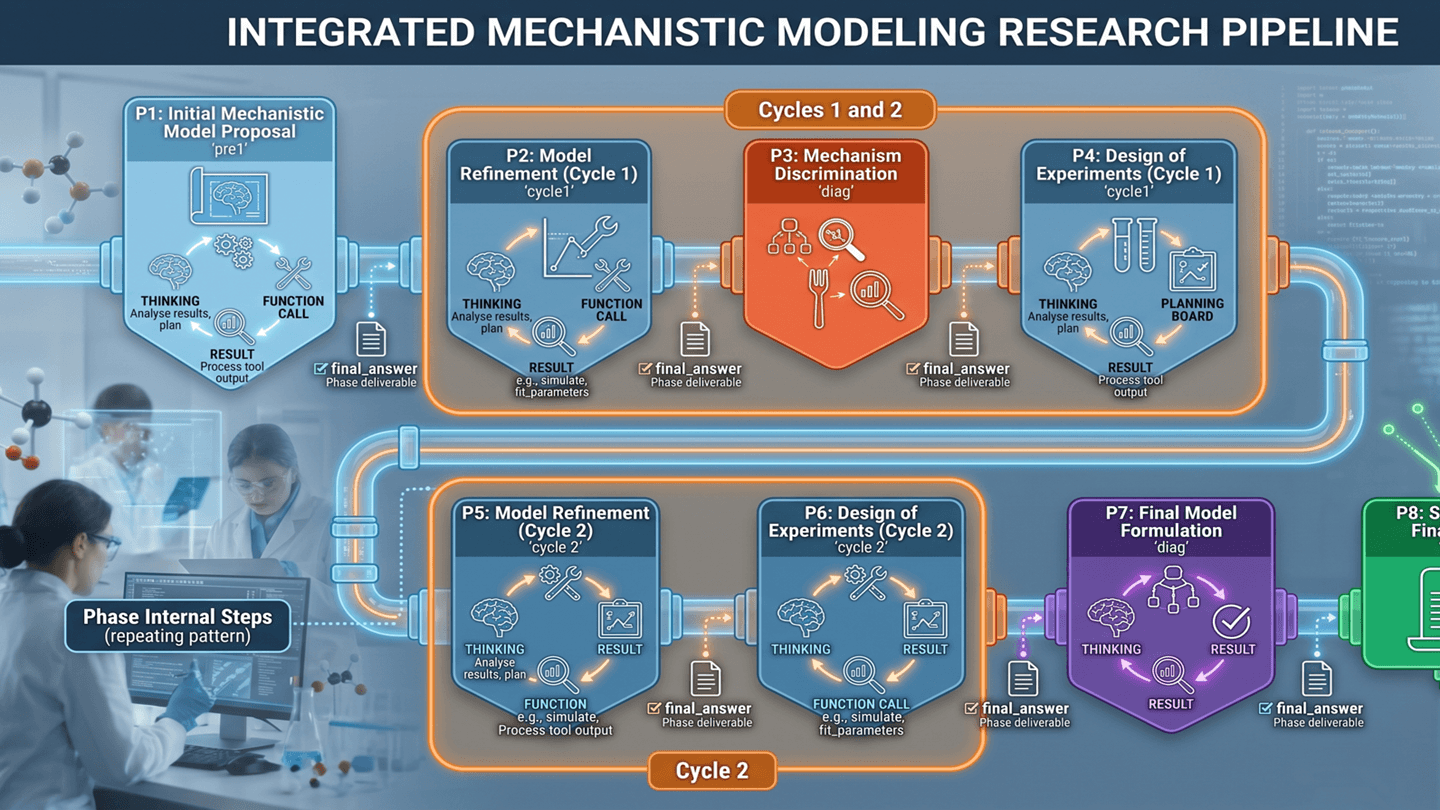
- Closes the AI discovery loop: hypothesis → experiment → inference, with human-in-the-loop gates.
- Built on Model Context Protocol (MCP) servers, each scientific capability packaged as an AI-accessible tool.
Core innovations:
- MCP-based scientific toolchain: Simulation, DoE, inference, and literature tools — composable for any LLM agent.
- Bayesian optimal design: Selects experiments that maximize information gain between rival theories.
- Auditable orchestration: Full audit log of AI vs human decisions across the loop.
Impact
- ARIA & funders: Proof that AI can autonomously advance materials research — a model for self-driving labs.
- CKL: Leadership in knowledge-aware AI; 3 US patents, 2 Q1 publications, reusable MCP architecture.
- The Field: Design principles for scalable, low-energy neuromorphic computing — AI discovering theory, not just optimizing.
Industrial Directions
- Neuromorphic hardware and low-energy AI computing.
- Materials science R&D and semiconductor industries.
- Self-driving lab platforms for autonomous scientific discovery.
- Artificial Intelligence, Energy, Laboratory Automation, Manufacturing & Engineering, Materials Science & Engineering, Neuromorphic Computing, Research Infrastructure, Semiconductor Industry