The challenge
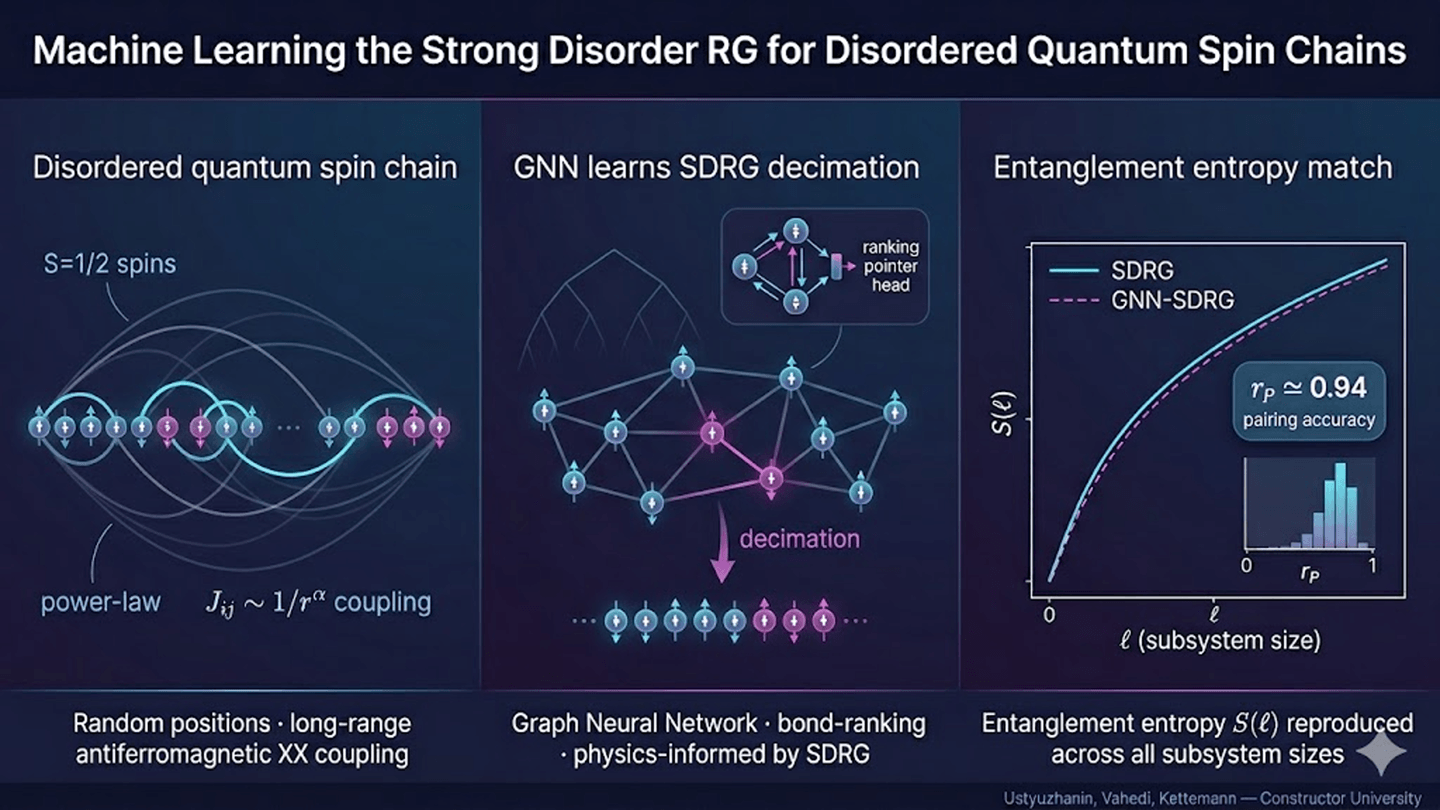
- Modeling entanglement in disordered long-range interacting quantum spin chains is computationally expensive.
- Exact diagonalization and DMRG scale poorly to large systems with long-range couplings.
- Strong-disorder RG (SDRG) is powerful but slow, and finite-temperature extensions (SDRG-X) add further cost.
The Solution
- ML models trained on SDRG as a physics-informed teacher to infer entanglement structure of disordered spin chains.
- Graph Neural Network (GNN) operates on the interaction graph and learns a bond-ranking rule mirroring SDRG decimation.
- Random Forest baseline for comparison; two-stage zero-T + thermal-sampling handles finite-T.
Core innovations:
- Physics-informed teacher: SDRG supervises the GNN at every RG step, not just final-state observables.
- Scale-invariant GNN: Edge-centric message passing with local normalization for SDRG-style scale invariance.
- Finite-T: Zero-T GNN + canonical sampling, no retraining.
Impact
- Quantum physics: Disorder-averaged pairing accuracy rₚ ≃ 0.94; entanglement entropy matches SDRG across all subsystem sizes.
- Method transfer: RG-flow heatmaps confirm the GNN learns the decimation hierarchy, not just final observables.
- Scalability: ML-assisted analysis of large disordered quantum systems where exact methods are prohibitive.
Industrial Directions
- Condensed-matter and quantum many-body physics.
- Quantum information and entanglement-based diagnostics.
- Physics-informed scientific ML and graph-based simulators.
- Precision Physics, Quantum Computing, Research Infrastructure, Science & Research, Scientific Instrumentation, Technology & Computing