The challenge
- Frontier experiments (HEP, precision tests) often report anomalies before cross-validation is possible.
- Unaccounted systematic distortions can masquerade as “new-physics” signals and drive premature claims.
- Standard profile likelihood handles known nuisance parameters only; no quantitative tool for unmodeled systematics.
The Solution
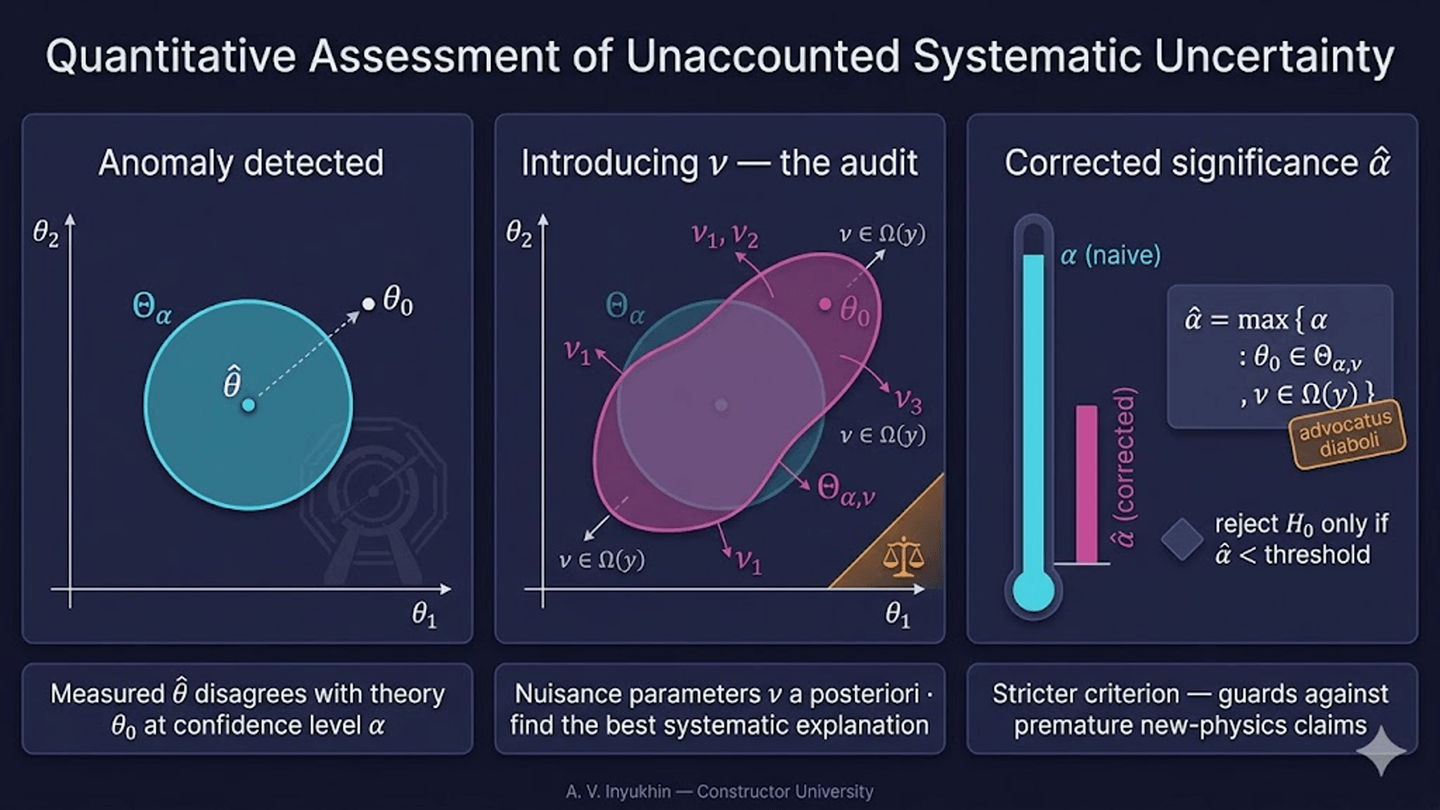
- Post-hoc framework for quantifying the impact of unaccounted systematic distortions on measurement results.
- Introduces nuisance parameters ν a posteriori, constrained by control measurements and physical priors Ω(ν).
- Reduces to constrained optimization of a test statistic, solved with classical methods.
Core innovations:
- Anomaly explanation: Search for ν that best explains the anomaly as a systematic; yields a corrected significance α̂.
- Worst-case search: Finds the largest allowed deviation under admissible ν, quantifying measurement vulnerability.
- Test correction: Reject H₀ only if no admissible ν explains the anomaly.
Impact
- HEP & precision experiments: Stricter, quantitative criterion for new-physics claims; guards against premature announcements.
- Reviewers: Quantitative vulnerability measure for published results and meta-analyses.
- Statistics: Complements profile likelihood; demonstrated on gamma-dispersion model and statistical-test corrections.
Industrial Directions
- High-energy and precision physics (CERN, Fermilab, Belle II, g-2).
- Statistical methodology and experimental design.
- Meta-science and reproducibility (systematics auditing of anomaly claims).
- AI-Scientist: Automated hypothesis generation and validation.
- Artificial Intelligence, Data & Analytics, Data & Intelligence, Precision Physics, Science & Research