The challenge
Traditional large-scale construction and manufacturing rely on rigid gantry systems or heavy machinery, which are costly, energy-intensive, and limited in scalability.
- Fixed portals restrict the size and geometry of processed objects.
- High metal consumption increases both capital and operating costs.
- Deploying equipment to different sites requires complex logistics.
The Solution
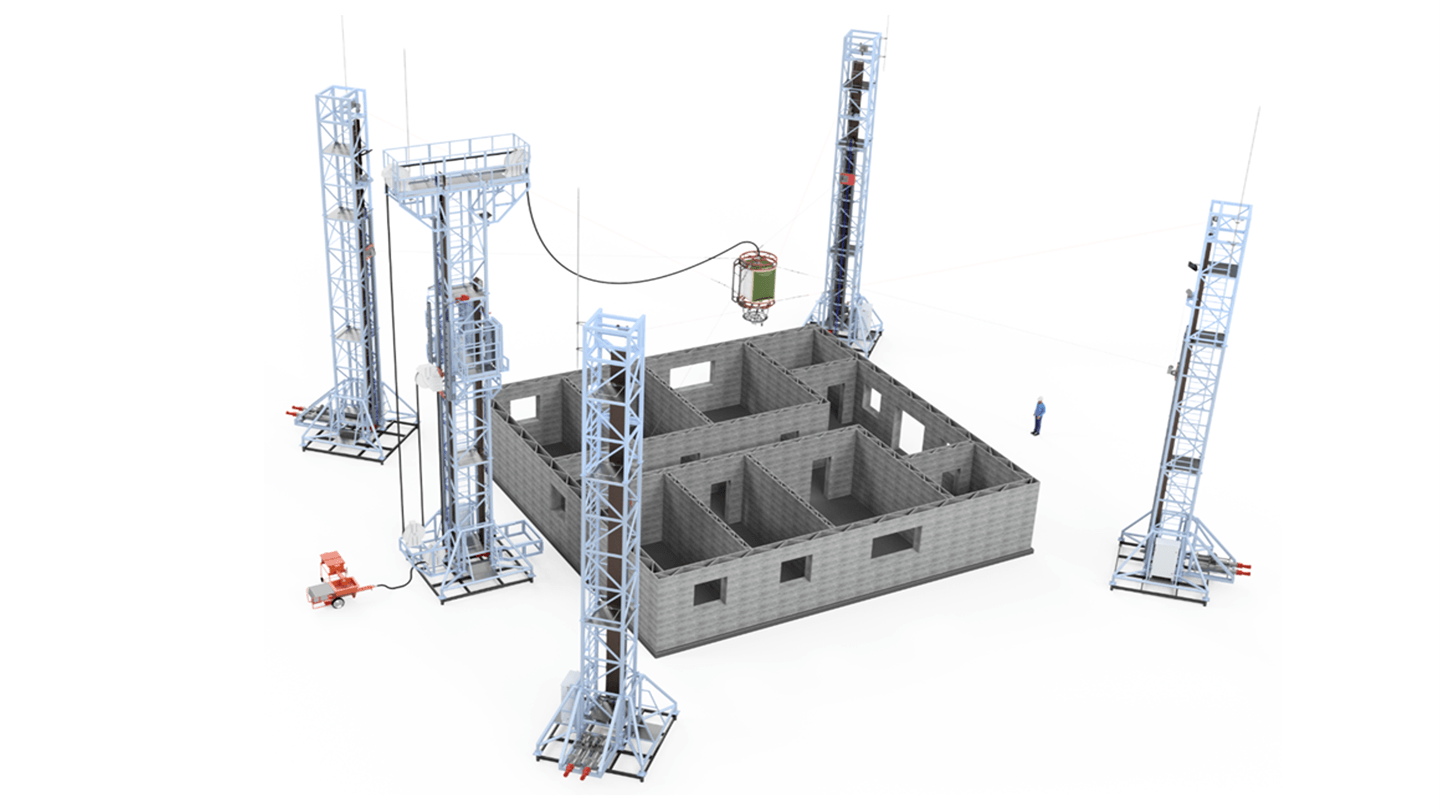
An autonomous cable-driven robot has been developed as a fault-tolerant, lightweight, and scalable alternative to conventional systems. The platform suspends a mobile tool on coordinated winches and cables, delivering precise multi-axis control across a vast workspace.
Key capabilities:
- Large-scale additive manufacturing: 3D printing of architectural forms, molds, or exoskeletal structures.
- Dynamic workspace control: direct cable actuation ensures exact tool positioning and orientation.
- Modular architecture: rapid installation in confined or remote sites.
- Material efficiency: significantly reduced metal usage compared to portal systems.
Test implementation: 3 × 3 × 6 meters.
Impact
- Supports the creation of structures of virtually unlimited dimensions.
- Cuts material costs by a factor of 2–5 compared to industrial manipulators, while maintaining industrial-grade precision.
- Decreases setup time and broadens deployment scenarios through modular installation.
This represents a shift from heavy, static machinery to agile, reconfigurable robotic platforms.
Industrial Directions
- Construction & architecture: 3D printing of buildings and large elements with reduced on-site labor (scalable from 10–15 m wide and 5 m high).
- Aerospace & shipbuilding: assembly, inspection, and coating of oversized components.
- Additive Manufacturing, Aerospace, Architecture, Construction, Engineering, Heavy Industry, Infrastructure, Manufacturing & Engineering, Robotics, Shipbuilding