The challenge
Conventional additive manufacturing systems are constrained by:
- Build volume and limited material options
- Slow reconfiguration between tasks
- Large or custom components
- Lengthy lead times and high costs
- Inability to use recycled or alternative feedstock efficiently
The Solution
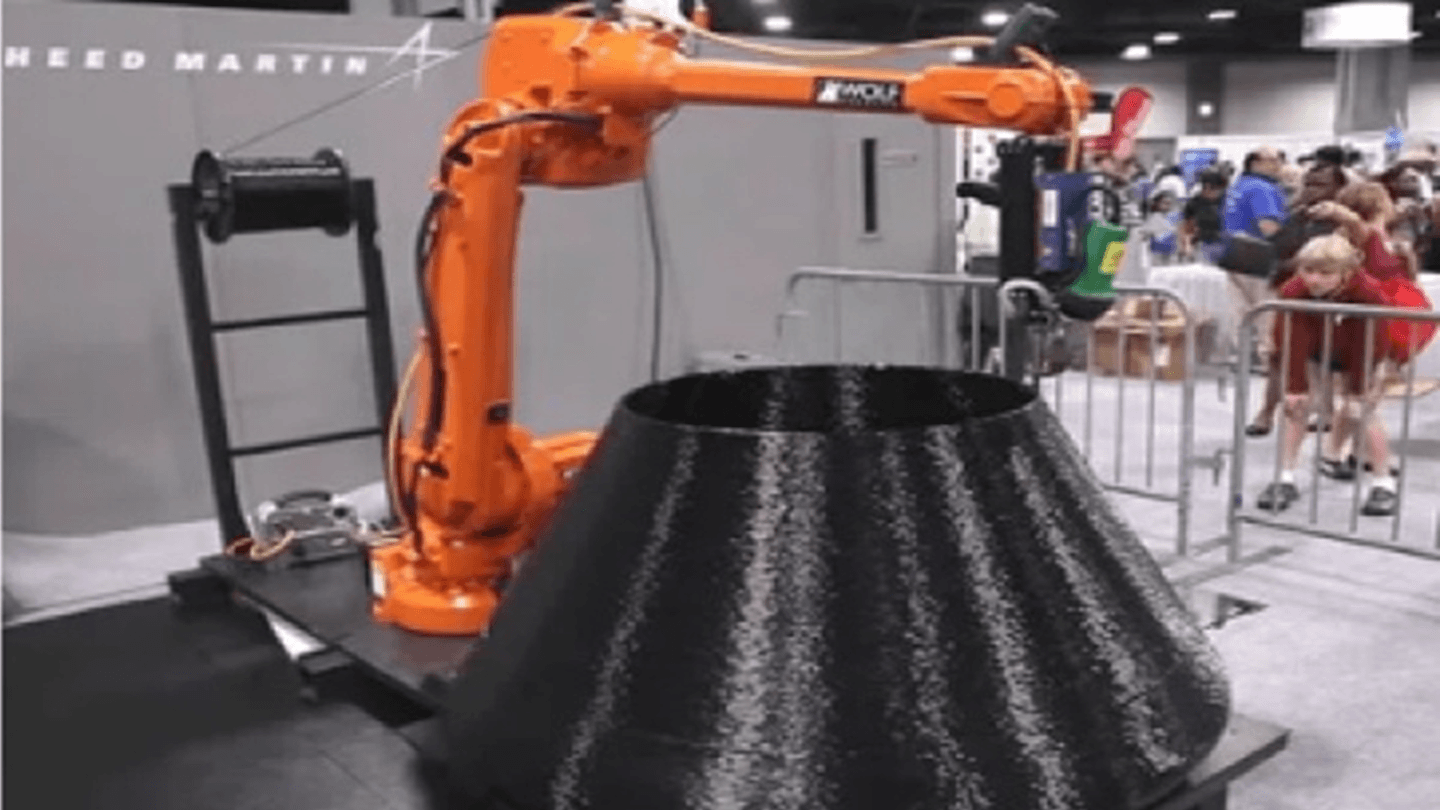
A robotic additive manufacturing cell, assembled from industrial-grade components and operated by custom-developed software, is purpose-built for large-format 3D printing. It works with granular feedstock and delivers scalability, precision, and versatility that traditional printers cannot match.
Key capabilities include:
- Material flexibility: prints with plastics,
recycled materials, concrete, and even metals. - Scalability: virtually unlimited product length and quick adjustment between different product types.
- Integrated workflow: streamlined process covering data preparation, material loading, and extrusion-based printing.
- High repeatability: industrial-grade accuracy across complex geometries and production cycles.
Impact
The technology opens the door to cost-efficient production of molds, prototypes, and functional parts that were previously impractical to manufacture at scale. By supporting recycled feedstock and multiple materials, it lowers environmental impact while expanding the range of industrial applications.
Organization benefits:
- shorter development cycles
- reduced dependency on external suppliers,
- the ability to deliver large or custom components on demand with consistent quality
Industrial Directions
Serves as flexible solution for industries that demand large-scale, customized, or complex components.
- Accelerates aerospace and automotive prototyping,
- Enables construction with oversized and architectural elements
- Gives manufacturers and designers a reliable tool for producing molds, models, and functional parts.
- Additive Manufacturing, Aerospace, Automotive, Construction, Defense, Heavy Industry, Industrial Operations, Manufacturing & Engineering, Materials Engineering