The challenge
Existing crystal material generative models face two major bottlenecks:
- Symmetry gap: State-of-the-art diffusion models often produce asymmetric or physically implausible structures, missing critical Wyckoff/site-symmetry constraints that determine real material properties.
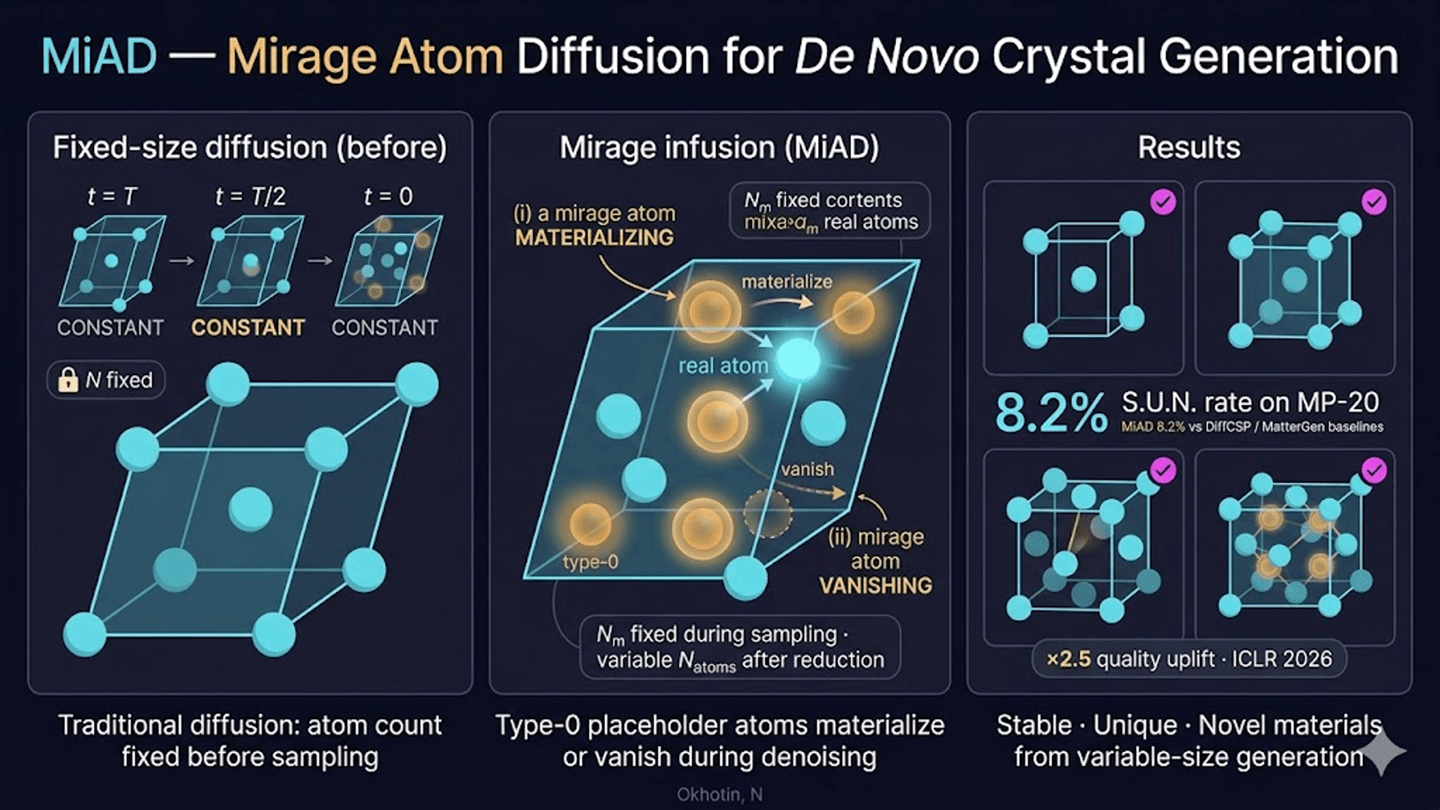
- Size rigidity: Most models fix the number of atoms during generation, limiting exploration
of new stoichiometries and topologies.
The Solution
- WyckoffTransformer
- Autoregressive Transformer trained on Wyckoff position tokens.
- Encodes space group and site symmetries, producing highly symmetric, realistic crystal templates.
- Mirage Atom Diffusion (MiAD)
- Extends generative diffusion to add/remove atoms dynamically, using mirage atoms as flexible placeholders.
- Enables exploration of variable-size crystal structures during sampling.
- Combined Pipeline
- WyckoffTransformer provides symmetry-constrained templates.
- MiAD performs dynamic structural refinement, expanding design space while maintaining symmetry and physical plausibility.
Impact
- Best-in-class S.S.U.N. & template novelty on MP-20 benchmark.
- Generates symmetry-respecting, stable crystals with +2× quality improvement vs. baseline diffusion models.
- Unlocks previously inaccessible structure families, enhancing novelty and functional diversity.
- Reduces DFT screening burden by focusing only on high-quality, physically meaningful candidates.
Industrial Directions
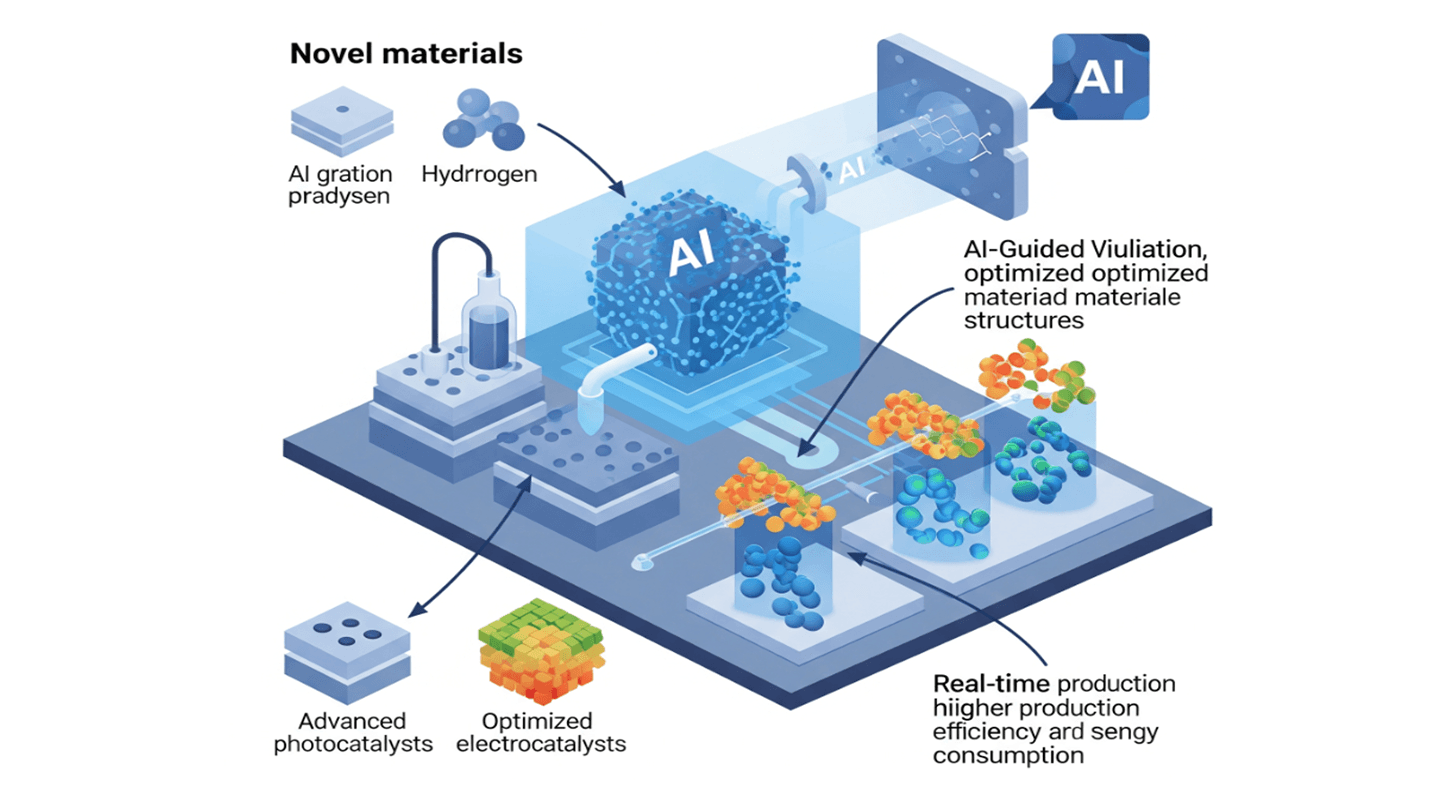
- Battery R&D – accelerated discovery of solid electrolytes and electrode materials.
- Semiconductor & quantum materials – generation of exotic phases with targeted electronic properties.
- Catalysis & energy – design of active sites
with novel symmetry patterns. - Automated materials pipelines – integration with MatterGen, pyXtal, or DiffCSP++ for fast, scalable exploration of the crystal design space.
- Advanced Materials, Battery Technology, Catalysis, Chemical Industry, Electronics, Energy, Materials Science & Engineering, Nanotechnology, Research & Development, Semiconductors