The challenge
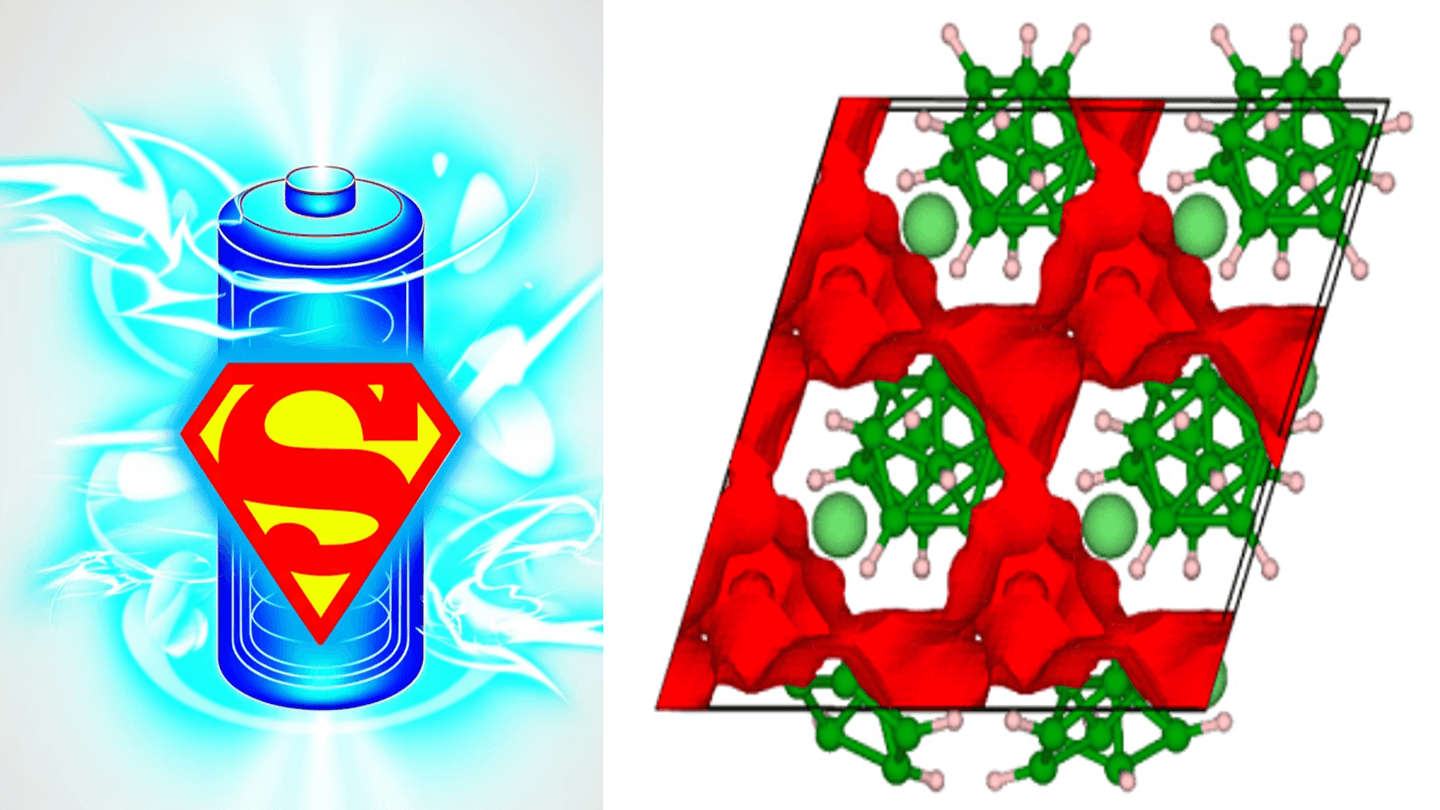
Discovery of new superionic conductors is critical for next-generation solid-state batteries (SSBs), which offer higher energy density and safety.
- Traditional DFT and molecular dynamics approaches for screening solid electrolytes are computationally expensive and difficult to scale to large materials databases.
- Machine-learned interatomic potentials (ML-IAPs) are fast, but their generalization errors can compromise the accuracy of conductivity predictions in unexplored atomic configurations
The Solution
- Develop a fast, reliable screening pipeline based on heuristic potential energy surface (PES) descriptors derived from universal ML-IAPs (e.g., M3GNet).
- Use frozen-framework PES scans and compute structural descriptors (Minimal Percolation Energy, Free Volumes) that correlate with Li-ion mobility while minimizing extrapolation error.
- Combine top-performing descriptors into a single SSE-ranking score (Φ) to rank 1300+ lithium-containing materials from the Materials Project.
Impact
50× faster than ML-driven MD and 3000× faster than ab initio MD:
- Identified 8 out of 10 top-ranked materials as superionic at room temperature, including previously unexplored high-performance candidates like LiB₃H₈ (σ ≈ 82 mS/cm at 363 K).
- Achieved an 8× enrichment in room-temperature ionic conductors among top candidates compared to random selection.
Industrial Directions
Accelerated discovery of solid electrolytes for all-solid-state lithium batteries, enabling:
- Safer, higher-energy EV batteries
- Long-lived grid storage solutions
- Portable electronics with improved stability
Integrable into materials design pipelines and generative models for targeted materials synthesis and optimization.
- Advanced Materials, Automotive, Battery Technology, Chemical Industry, Clean Energy, Electronics, Energy Storage, Grid Infrastructure, Materials Science & Engineering, Research & Development