The challenge
Manual inspection always requires divers, making exploration and monitoring beneath the waterline one of the most complex engineering tasks. Visibility is limited, pressure and chemistry vary sharply with depth, and access is often restricted or unsafe for divers.
Manual surveys are slow, expensive, and dependent on specialist availability, while many existing robotic systems cannot deliver synchronized sonar, video, and environmental data in one reliable mission.
The Solution
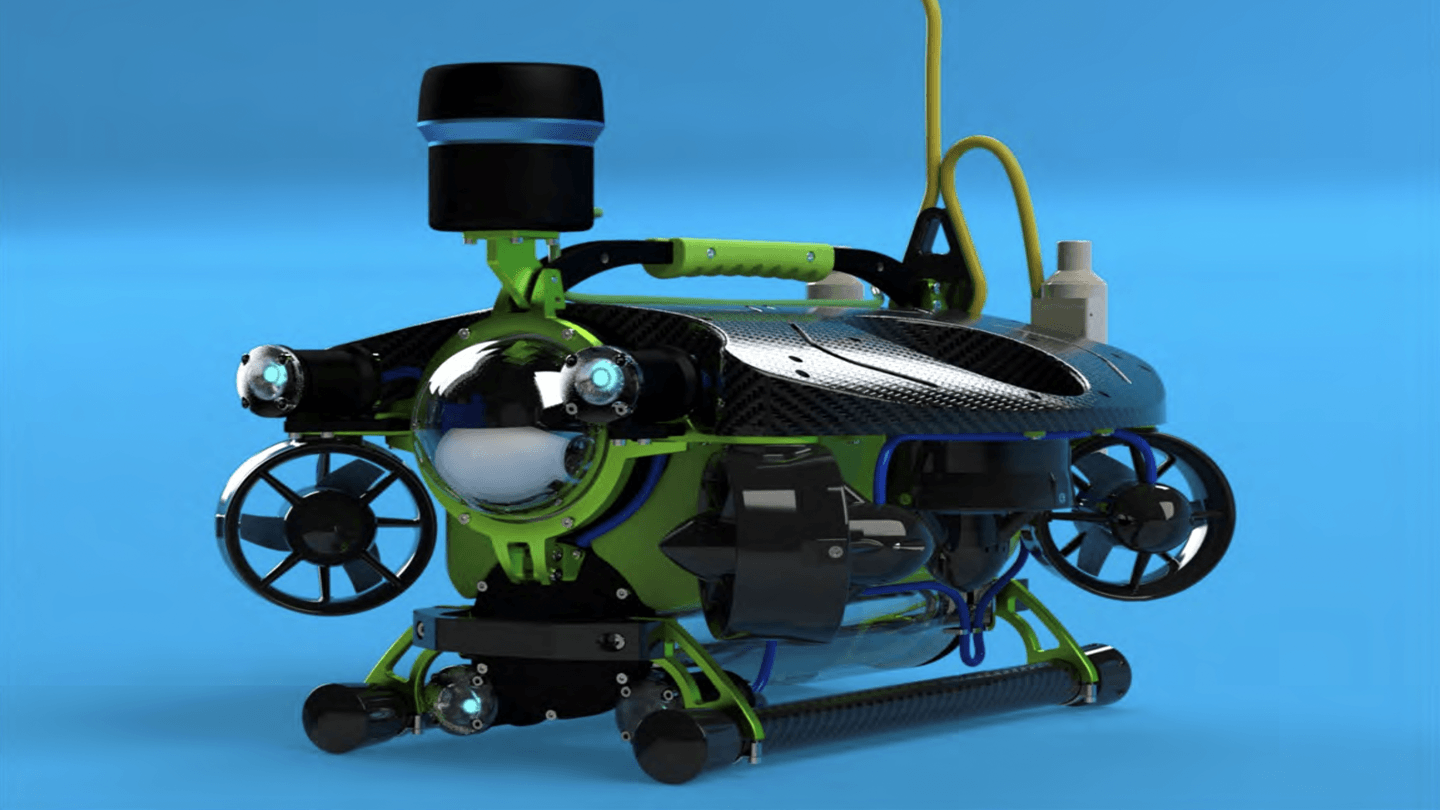
A compact unmanned underwater vehicle (UUV/ROV) was developed to execute tethered remote surveys of aquatic environments using modular sensor payloads:
- Captures sonar maps, HD video, and environmental data (temperature, pressure, pH) in a single mission.
- Follows pre-defined routes, delivering consistent, high-fidelity data.
- Designed for flexible deployment – lightweight and easy to launch from small vessels or shore.
- Autonomous recovery to the support vessel upon mission completion; no human intervention.
- Routine tasks are performed unattended; operators engage only when required.
Impact
- Reduces inspection cycles by compressing hours of diver-based work into minutes of robotic survey.
- Consolidates sonar mapping, video capture, and environmental sensing into one coordinated mission.
- Improves safety by removing human operators from risky or inaccessible waters.
- Delivers consistent, high-quality datasets that strengthen inspection reliability and decision-making.
Industrial Directions
The technology finds application in:
- Aquatic infrastructure: pipelines, dams, submerged assets in marine, river, and lake environments
- Environmental monitoring: water quality, ecosystem mapping
- Search & recovery: submerged objects, debris, artifacts, cracks, damage, and leaks
- Defense, Energy, Environmental & Sustainability, Infrastructure, Marine Engineering, Maritime, Offshore, Oil & Gas, Research & Development, Utilities