

Research Portfolio
Prof. Dr. Giancarlo Succi is a leading researcher in software engineering whose work at Constructor Labs combines artificial intelligence, empirical software engineering, human factors, and software process innovation. His research focuses on AI-assisted software development, software quality, agile and DevOps methodologies, software architecture, and the application of data-driven and empirical methods to improve how software is designed, developed, and maintained. A distinctive aspect of his work is the integration of behavioral sciences into software engineering, using physiological signals such as EEG, eye tracking, and other biometric measurements to understand developers’ cognitive processes, collaboration, stress, and decision-making. This research provides the scientific foundation for next-generation AI systems that enhance both software development and human productivity.
Over more than three decades, Prof. Succi has combined fundamental research with industrial impact through collaborations with companies and public organizations across Europe, North America, Asia, and Australia. His expertise spans software engineering, software metrics, software architectures, agile development, software product lines, DevOps, software reuse, API engineering, and software process improvement. Alongside his academic career at the University of Bologna, the Free University of Bozen-Bolzano, the University of Alberta, the University of Calgary, and Innopolis University—where he served as Dean of the Faculty of Computer Science and Engineering—he has advised numerous industrial organizations on improving software development practices and engineering processes. This combination of academic excellence and industrial engagement enables Constructor Labs to translate cutting-edge research into practical AI-enabled software engineering solutions.
Beyond his research, Prof. Succi has an extensive record of academic leadership and educational innovation. Since 2025, he has served as Interim Dean of the School of Computer Science & Engineering at Constructor University. Throughout his career, he has developed international degree programs, promoted entrepreneurship in computing education, secured major educational research initiatives, and mentored generations of researchers and software engineers. At Constructor Labs, his expertise strengthens the development of trustworthy AI technologies for software engineering, intelligent educational platforms, and human-centered digital systems, ensuring that advances in artificial intelligence are grounded in rigorous empirical evidence, engineering excellence, and real-world applicability.
Neurosymbolic System Architectures
Investigates software architectures that combine large language models, symbolic reasoning, formal knowledge representations, and rule-based inference. The focus is on building systems in which statistical AI components generate, interpret, or summarize information, while symbolic layers provide explicit constraints, traceable decisions, consistency checks, and explainable reasoning. This direction is particularly relevant for software engineering tasks that require both flexible interpretation and rigorous control, such as environment reconstruction, dependency diagnosis, automated repair,
and reproducible software execution.
Biophysical Systems for Understanding Software Processes
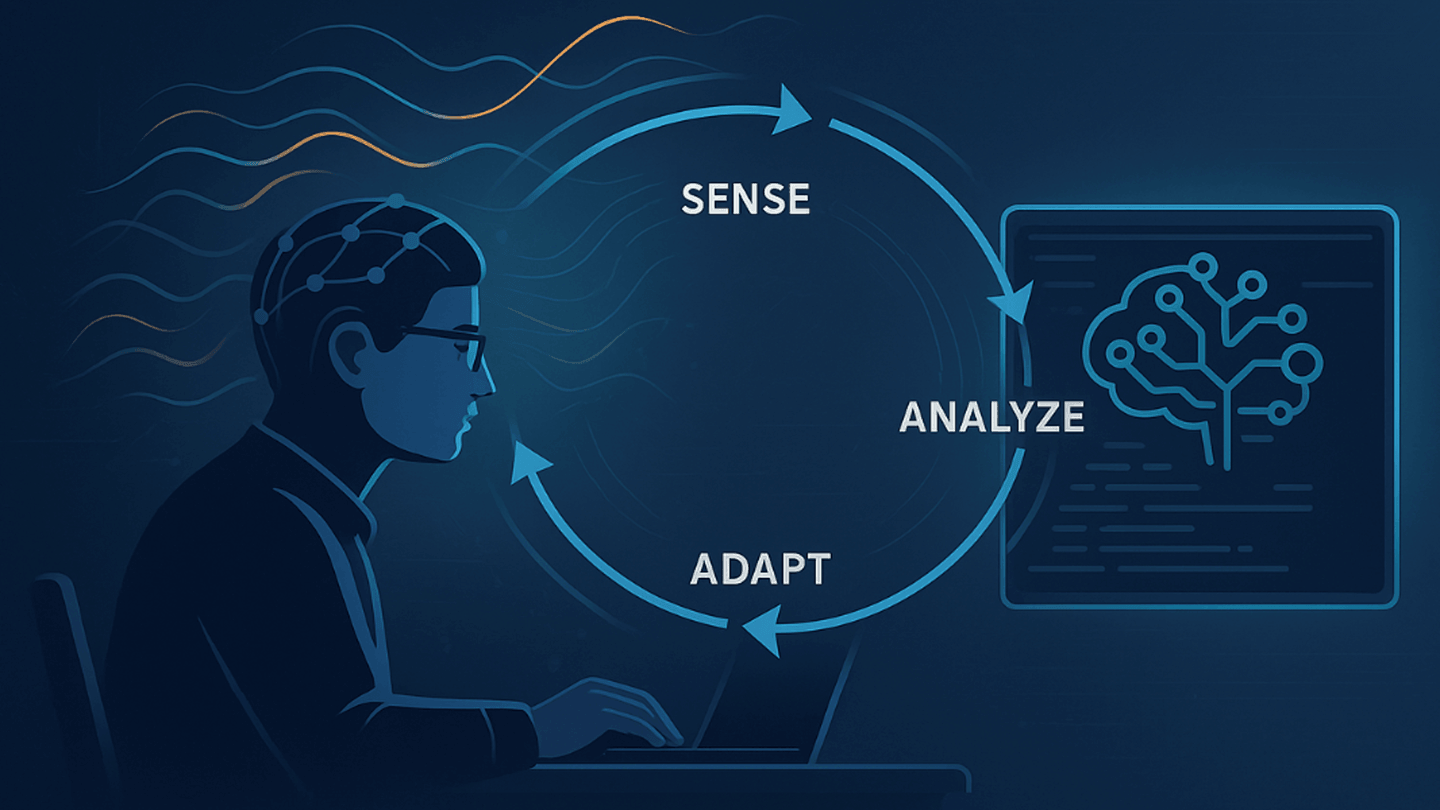
Studies how biophysical and psychophysiological signals can support a deeper understanding of programmers’ feelings, emotions, cognitive load, stress, attention, and thought processes during software development. The research explores the use of instruments such as eye tracking, EEG, heart-rate variability, galvanic skin response, motion sensors, and other biomedical devices to observe how developers reason, debug, collaborate, and react to errors or uncertainty. The goal is to connect software process analysis with human factors, enabling better empirical models of programming activity, team coordination, developer well-being, and AI-assisted software engineering.
Cognitive Architectures for Software Engineering
Explores the design of cognitive architectures that model, support, and
extend the reasoning processes involved in software development. This includes architectures inspired by human cognition, psychoanalytic theory, organizational patterns, and multi-agent reasoning, where memory, attention, perception, symbolic knowledge, and decision-making mechanisms interact. The objective is to create systems able to represent not only code and execution artifacts, but also intentions, assumptions, conflicts, dependencies, and evolving mental models of developers and teams. This research direction supports more transparent, adaptive, and human-aware AI systems for software engineering.

- Mazzara, Manuel, Giancarlo Succi, and Alexander Tormasov.
Innopolis university-from zero to hero: Ten years of challenges and victories.
Springer Nature, 2022. - Ferrario, G., Mikriukov, A., Plaksin, Y., Sitnikov, V., Succi, G., Tormasov, A., & Trofimova, E. (2025, May).
Evaluating cost-effectiveness and coherence of LLMs for supplement recommendations using routing techniques.
In 2025 10th International Conference on Machine Learning Technologies (ICMLT) (pp. 350-354). IEEE. - Dlamini, G., Huraira, A., Kholmatova, Z., Mikriukov, A., Safiullina, G., Succi, G., & Tormasov, A. (2025).
A systematic literature review on measuring brain activity while reviewing code and paintings.
IEEE Access. - Mikriukov, A., Senokosov, A., Succi, G., Tormasov, A., Plaksin, Y., Trofimova, E. and Sitnikov, V.
AI Tools for Automating Systematic Literature Reviews
In: Proceedings of the 2025 International Conference on Software Engineering and Computer Applications (pp. 25-30).
Date of publication: 27 August, 2025
DOI: https://dl.acm.org/doi/10.1145/3747912.3747962 - Mikriukov, A., Plaksin, Y., Ravveduto, A., Succi, G., Tormasov, A. and Trofimova, E.
Auto-Configuration of the Constructor Research Platform
In: Proceedings of the Future Technologies Conference (pp. 616-621). Cham: Springer Nature Switzerland.
Date of publication: 16 October, 2025
DOI: https://doi.org/10.1007/978-3-032-07989-3_40 - The creative mind: examining brain waves in drawing and programming through EEG images ( Zamira Kholmatova; Ilaria Cutica; Gcinizwe Dlamini; Abu Huraira; Davide La Torre; Riccardo Sartori; Guzel Safiullina; Michele Scandola; Mariia Snigireva; Giancarlo Succi)
- Ciancarini, P., Farina, M., Mikriukov, A., Succi, G., Tulkunova, N., Tormasov, A., Thapaliya, A. and Zuev, E
A Systemic Perspective on Software Engineering
In: Proceedings of the 2025 18th International Conference on Computer Science and Information Technology (pp. 91-97), Bilbao, Spain.
Date of publication: 27 October, 2025
DOI: 10.1145/3783862.3783875 - Anbar, F., Mikriukov, A., Plaksin, Y., Sitnikov, V., Succi, G., Tormasov, A. and Trofimova, E.
Toward an understanding of the self-coherence and the cross-coherence of LLMs — An empirical investigation
In: International Conference on Computer and Communication Engineering (pp. 127-137).
Date of publication: 10 November, 2025
DOI: https://doi.org/10.1007/978-3-032-06757-9_12 - Mikriukov, A., Plaksin, Y., Ravveduto, A., Snigireva, M., Succi, G., Tormasov, A., & Trofimova, E.
A preliminary analysis of the current limitation and future directions of AI applied to the legal domain based on a SLR
In: 2025 International Conference on Data Science and Intelligent Systems (DSIS) (pp. 1-10). IEEE.
Date of publication: 28 November, 2025
DOI: 10.1109/DSIS67228.2025.11390564 - Adashchik, A., Huraira, A., Kholmatova, Z., Mikriukov, A., Ravveduto, A., Snigireva, M., Succi, G., Tormasov, A. and Trofimova, E.
Agentic LLM Pipelines for Reproducible Scientific Software: Opportunities and Challenges
In: Proceedings of the 2025 9th International Conference on Computer Science and Artificial Intelligence (pp. 38-46)
Date of publication: 12 December, 2025
DOI: https://doi.org/10.1145/3788149.378822
Rumen Mitov
PhD student
Expertise spans operating systems, systems programming, and low-level software, with hands-on experience across microkernel architectures and persistent systems – including leading much of the implementation work on PhantomOS, presented at FOSDEM 2026. Current work is part of the Code project, which sits at the intersection of systems, programming languages, and AI-based tools for software development.