The challenge
- The productivity and creativity of software developers depend directly on their mental condition – the mind is their primary instrument.
- Current IDEs and development environments are blind to the developer’s cognitive and emotional state.
- There is a need for adaptive systems that understand and react to the mental states of developers in real time.
The Solution
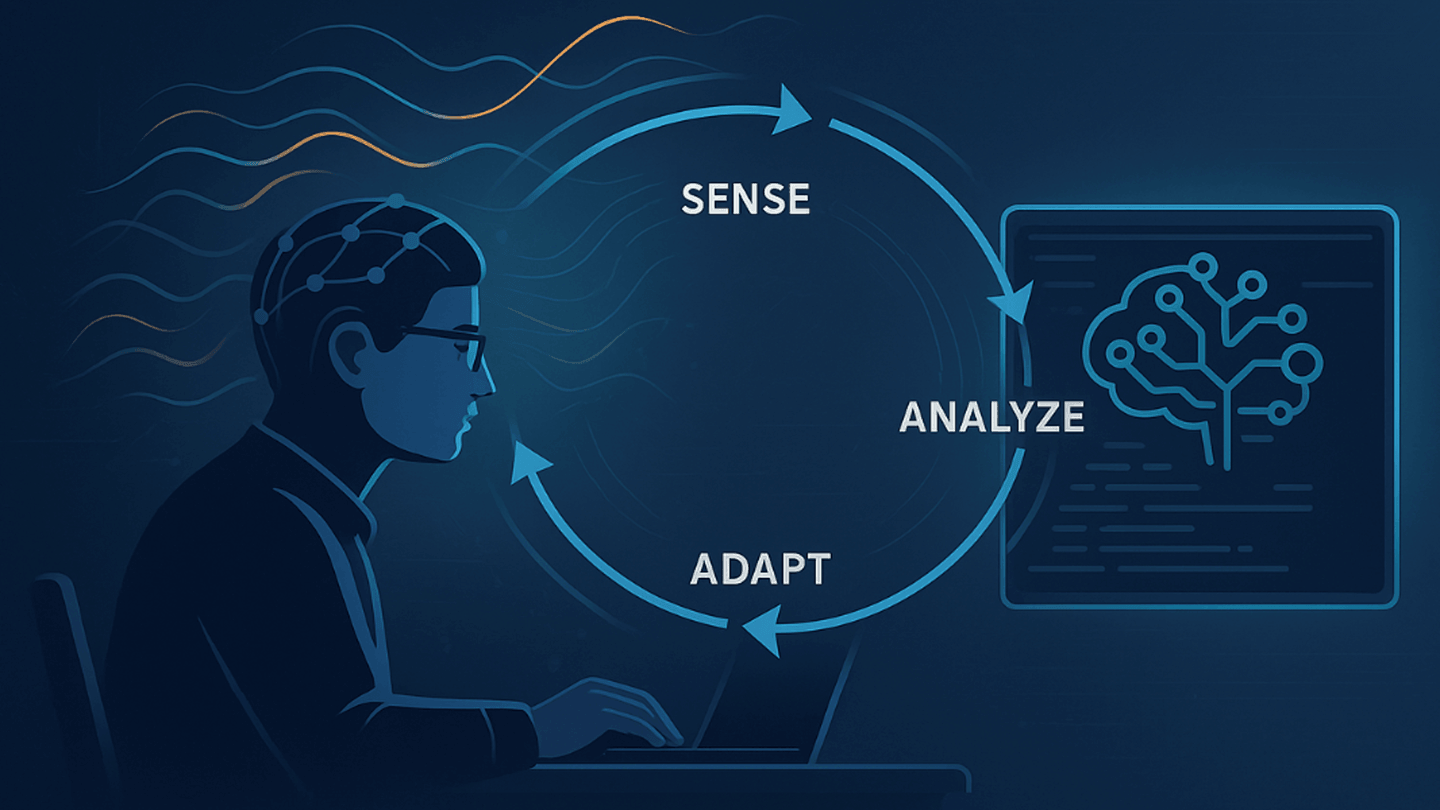
- A neuro-adaptive IDE integrating real-time machine-learning-based mental-state modeling, previously trained with EEGs.
- The system is trained using multichannel wearable EEG devices to identify cognitive states such as concentration, cognitive load, and stress, by how the developers interacts with the system
The IDE dynamically adjusts its interface and assistance features according to these detected states, such as:
- Reduces visual and auditory distractions when overload is detected,
- Suggests breaks or calming stimuli when stress rises,
- Enhances guidance and code analytics when high focus is detected.
This closed loop transforms raw actions on the computer into meaningful, actionable insight, improving the quality of work it supports.
Impact
- Adaptive user experience that maintains optimal cognitive engagement and reduces burnout.
- Higher code quality and developer well-being, validated through correlations between brain-state metrics and performance indicators.
- Foundation for next-generation human-centric development environments that merge neuroscience with software engineering.
- Possibility to create an eco system of integrated tools based on smart wearable to improve the quality of software production
Industrial Directions
- Educational environments: optimizing learning and focus inprogramming courses.
- Software development and IT operations: cognitive monitoring for performance and safety-critical coding tasks.
- Human-computer interaction and ergonomics: adaptive workstations using neural feedback.
- Broader creative industries requiring sustained mental focus and minimal stress.
- Creative Industries, Digital Platforms & Transformation, Education, Enterprise IT, Enterprise Software, Human Performance & Workplace, Human–Computer Interaction, Software Development