Every 10 °C of extra heat roughly halves the lifetime of an electronic device. That rule of thumb ran through much of the hardware story presented at the latest CKL/CSE Seminar.
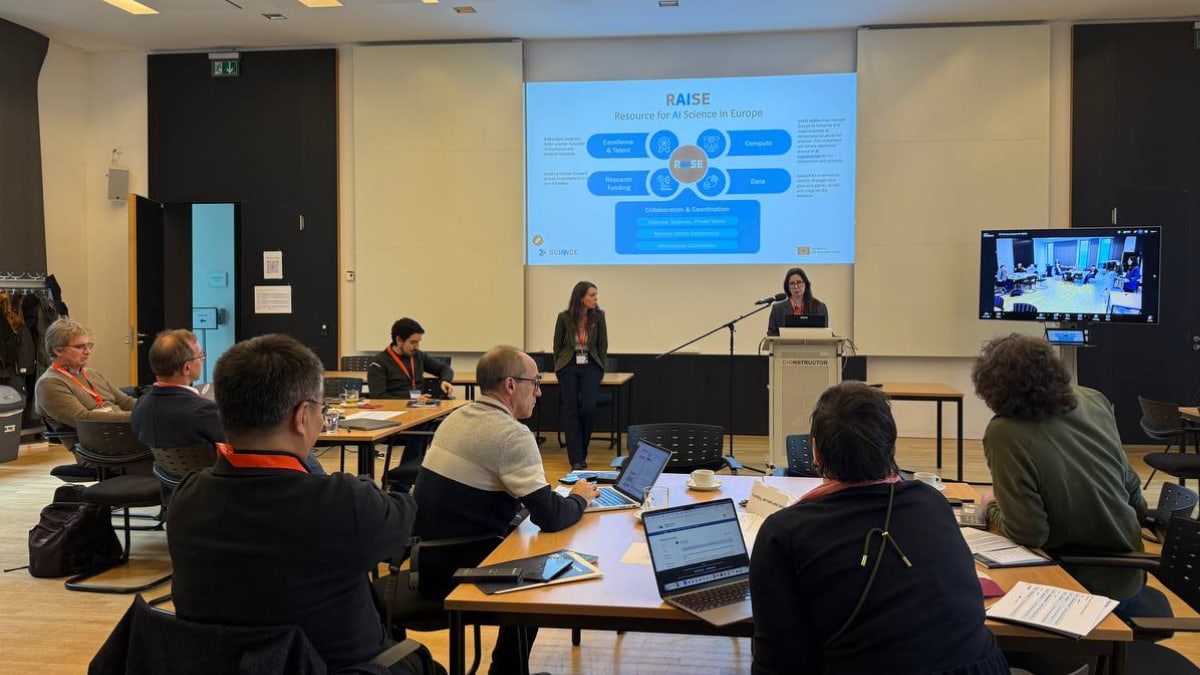
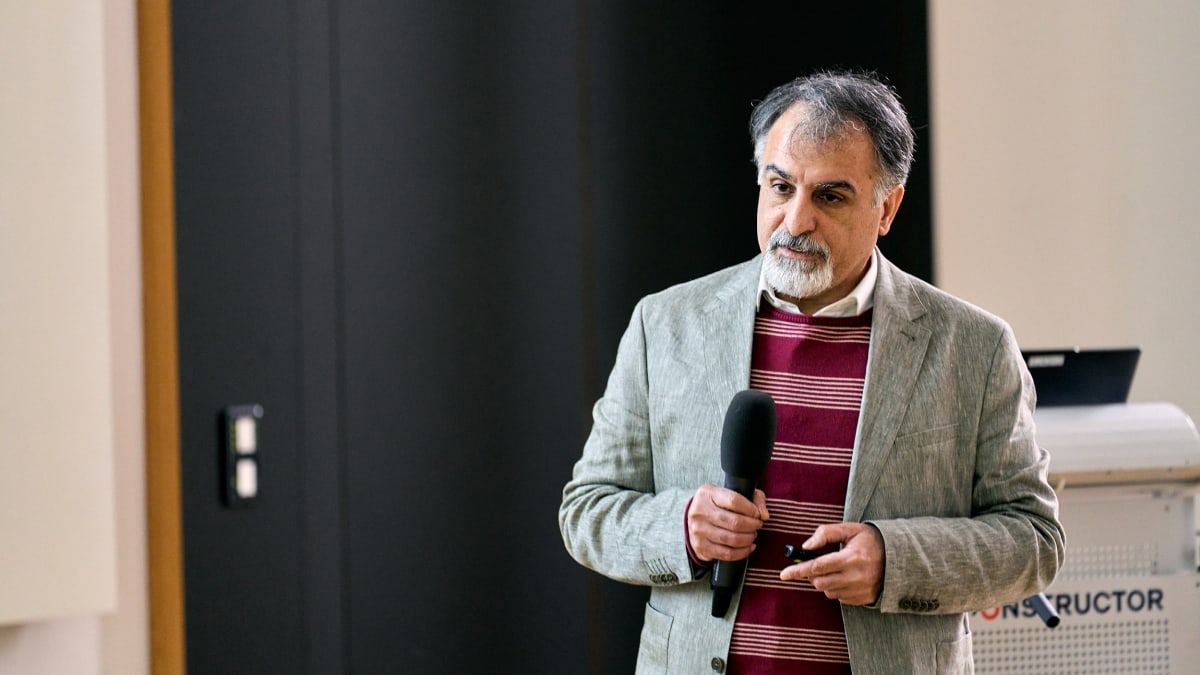
On 22 October, Constructor Knowledge Labs (CKL) and the School of Computer Science and Engineering (CSE) at Constructor University hosted Prof. Dr.-Ing. Mojtaba Joodaki, Professor of Computer Science and Electrical Engineering and Study Program Chair of Electrical and Computer Engineering, with the talk “From Nanodevices to Metasurfaces: Engineering the Hardware Behind Intelligent, Connected Systems”. More than 160 people followed the seminar, in the IRC Conference Room in Bremen and online.
Prof. Joodaki’s career spans both industry and academia: a PhD at the University of Kassel, R&D roles at Atmel, Infineon and Qimonda, ten years as a professor at Ferdowsi University, and Constructor University since 2020. The talk drew on all of it.
From his industry years, he presented a collector-up SiGe heterojunction bipolar transistor that raised the transit frequency by more than 20% and the maximum oscillation frequency by more than 80% within the same technology, and a buried word-line DRAM architecture that reduced the memory cell from 8F² to 6F². Looking back, he noted that Germany’s withdrawal from memory production looks like an expensive decision now that AI is driving memory demand and prices upward.
A central thread was quasi-monolithic integration. Gallium nitride on silicon carbide costs roughly a hundred times more than silicon, yet most of a microwave chip’s area is taken up by passive structures. Embedding only the active devices into a silicon substrate cut interconnect loss at 40 GHz from 1.6 dB with wire bonding to 0.4 dB and substantially lowered peak channel temperatures in simulation.
Current work in his group covers resistive memory, where layer thickness alone decides whether a device behaves as permanent, non-volatile or short-term memory for neuromorphic computing; flexible organic solar cells, whose efficiency can increase under mechanical strain; microwave sensors with a 50 µm limit of detection for liquid levels; metasurface antennas only 0.004 wavelengths thick; and a patented “wrapped PCB” design that reduces radiated noise by more than 20 dB.
In the Q&A, one participant asked whether such technologies could help with restaurant odours in residential neighbourhoods. Prof. Joodaki admitted that sensing and recording smell is a fascinating field, though far from his own. The discussion continued after the session around the wrapped PCB, including its parallel with twisted-pair cabling and how the geometry has to shrink as frequencies rise.
Key takeaways:
– Most of the cost of high-frequency electronics lies in the substrate and passive structures, so integrating only the expensive active devices into silicon reduces cost, losses and heat together.
– Thermal design is a reliability question: every 10 °C of extra heat roughly halves device lifetime.
– Hardware for AI starts at the materials level, as resistive memory shows for neuromorphic applications.
– Microwave sensors combined with neural networks can turn simple RF measurements into accurate material analysis, while reliable dielectric data for biological tissues is still missing, with literature values for skin, hair or bone differing by up to a factor of 100.
– As supply voltages fall from 5 V to below 1 V and switching frequencies climb, noise becomes a design constraint from the first layout, and EMC expertise stays in constant demand.
Prof. Joodaki closed with an open invitation to collaborate, particularly with computer scientists working on hardware for AI, neuromorphic memory, antennas, energy harvesting and EMC.
We thank Prof. Joodaki for the talk, our CSE colleagues for co-organising the series, and everyone who joined us in Bremen and online. The next CKL/CSE Seminar will be announced soon.